I Get It
A dispatch from the Special Executive for Chicken Tenders, Rage, Unemployment, and Memorization

I’ve alluded in past posts, and even in my bio, to being autistic. And technically I am — at least, according to the current definition of autistic, which you have to admit has changed radically several times within very recent history. Even those who believe that 100% of the people currently labeled as autistic are really and truly autistic cannot deny this. It’s just a fact.
It’s also a fact that autism is not a disease in the same sense that, say, cancer or HIV is a disease. You cannot take a biopsy and observe autistic cells, or draw a blood sample and detect autistic antibodies. This is absolutely not to say that autism isn’t a “real” disease — you can’t do those things with schizophrenia either, or with any number of other psychological conditions that nobody disputes are “real.”
What this does necessarily mean, however, is that there’s no such thing as proof regarding who has it and who doesn’t.
There are people who are indisputably autistic, of course. There is no need for me to describe what those people are like here — if you are bothering to read this essay, then you have presumably read others that do so in great detail.
But — as the term spectrum implies (a term invented, appropriately enough, by Isaac Newton, who was, as everyone knows, autistic) — there are lots of autistic people who aren’t “like that.” It is them — wait, I mean us — no, them — no, us — fuck it, it’s these people I want to talk about.
The ones who aren’t, you know, autistic autistic, but who are still definitely autistic, because therapists said so, and therapists are honorable men — wait, I mean women.
I’m sure you’re aware of the recent headlines about how 1 in 20 school-aged American boys is now autistic (meaning autistics in the young male generation now significantly outnumber both gays and Jews), with the rate for boys in California being an eyebrow-raising 1 in 12 (outnumbering the green-eyed, and rapidly gaining on the left-handed, at least among males).
Right-wingers tend to look for an environmental cause when attempting to explain these numbers, with varying degrees of conspiracy-mindedness. Liberals, for their part, point to “improved diagnostic criteria.” Between these two options, I tend to favor the left-wing viewpoint — with the considerable caveat that I dispute its usage of the term improved.
Just because you are saying that more people have a condition, that doesn’t mean you are accurately saying so. This is the sort of thing that tends not to occur to the American Left, which will gladly do whatever it can to swell the ranks of any given minority group, presumably based on the reasoning that greater numbers will lead to less discrimination. By way of comparison, just look at what has been done with the term queer in recent years. I’m old enough to remember when it was merely a synonym for “gay” — but by current standards, kinky people are queer, as are people who have no interest in sex at all. People who like pineapple on pizza will presumably be calling themselves queer by this time next year. I mean, why not? The more people who are “queer,” the better, right?
I was always considered weird, especially when I was in school, but (as far as I know) nobody ever suggested that I was autistic until a girlfriend’s mom clocked me as such when I was in my early 30s. This person was a licensed, practising psychiatrist who specialized in working with autistic kids in schools, so she was absolutely professionally qualified to make that call — though, it must be said, she made it based on meeting me socially, not on working with me as a patient.
An argument might be made that, as I was meeting my girlfriend’s parents for the first time, I was understandably nervous and perhaps not behaving typically, and that this was therefore not the most scientifically rigorous time for a diagnosis. An argument might even be made that, as this woman was not making this call on the professional clock, she might have felt less than her usual levels of compunction and just said this because she didn’t like me and wanted her daughter to break up with me (which she did).
But hey, it’s not like my (ex-)girlfriend’s mom’s opinion was the only piece of evidence I was ever going on here. Looking for subsequent confirmation one way or the other, I took the ASQ (Autism Spectrum Quotient) and got a 38 (the highest possible score is a 60, you are officially autistic at 26, and you are significantly autistic at 32). Still skeptical and wanting some control data, I had a few of my friends1 — all of whom are huge nerds — take the test as well, and the highest score that any of them racked up was a 12.
The therapist I was working with a while afterwards was not a medical doctor and therefore not qualified to diagnose but said it certainly seemed as though I fit the criteria. I balked at a referral to her colleague for an official diagnosis because by that time I was going through a divorce and custody battle, and an official diagnosis of autism (or anything) would have been something I’d have had to disclose on the stand if asked, and which could have imperiled my access to my child. (For this reason, I have avoided being officially diagnosed to this day.)
My own research, too, uncovered a lot of corroboration from my lived experience. In childhood I exhibited both hyperlexia (I could read at an adult level at two) and echolalia (I did that thing where I repeated the ends of my own sentences under my breath for a while, around ages 8-9; luckily, my dad was around to make fun of me until I stopped). I had a habit of staring at myself in mirrors during conversation instead of at the other person (once again, my dad made fun of me until I stopped). My interests tended to be monomaniacal — I spent ages 3-7 unwilling to read or talk about anything besides dinosaurs, ages 8-10 unwilling to read or talk about anything besides sharks, ages 11-14 unwilling to read or talk about anything besides the Beatles, etc. (this part, my dad encouraged).
There all along have been also, it should be said, some compelling indications that I might not be autistic. Autistics tend to struggle with figurative language, and yet I hold a Masters in Poetry from the most prestigious institution in that field on the face of the earth. Autistics have trouble both comprehending and creating humor, but even my worst enemy would admit that I’m extremely funny.
“What are you even talking about?! This is not debatable!! You have meltdowns!!”
Yes, I do. What’s interesting about that, though, is that I never had one — not once in my life — until after I was informed that I was autistic, and after reading up on autism and finding out what meltdowns are.
In other words, my supposedly autistic ass somehow managed to make it through about 35 years of existence — including high school — without ever having a meltdown, and then started having them in middle adulthood after learning what they were and that I was supposed to be having them.

But therapists say I am autistic, and therapists are honorable women.
So my favorite food is mac ‘n’ cheese with cut-up chicken nuggets in it. So what? That doesn’t prove anything. Mac ‘n’ cheese with cut-up chicken nuggets is objectively delicious. It’s impossible not to like it. Frankly, I think everyone else is just pretending they don’t like it in order to seem grown-up and sophisticated.
Hey, I understand. It’s fine to say and do fake bullshit to seem sophisticated — acting that way can get you things in life, and it’s logical to want the things that it can get you.
But someone who declines to act that way doesn’t necessarily have a disease.
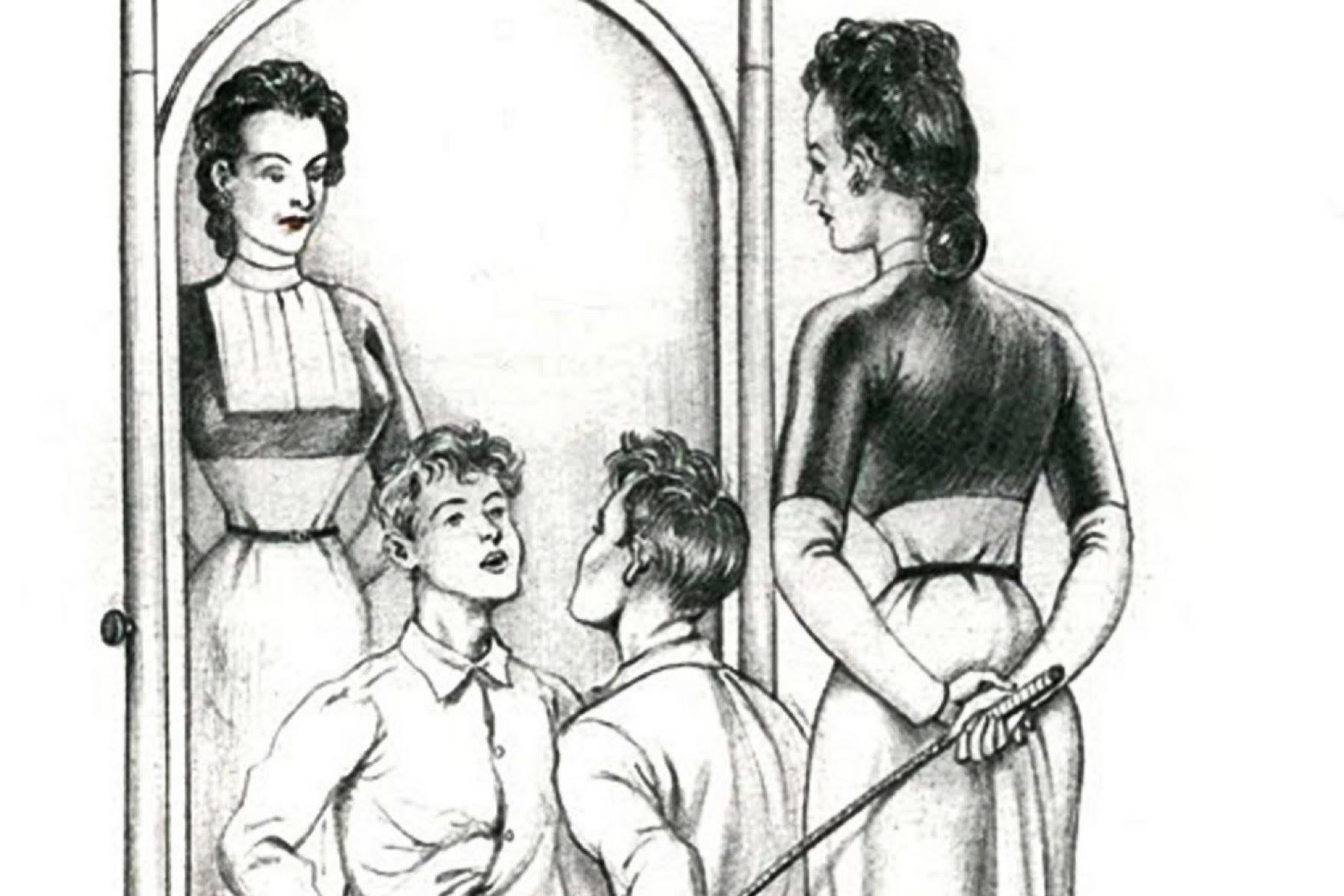
Once again, I am not saying that autism isn’t real. Many of the “autistic” boys in California presumably really are autistic — just like how some of the women diagnosed with “hysteria” in 1905 probably really were schizophrenic or whatever. But lots of them — maybe even most of them — were, as all good people now admit, perfectly sane women who merely behaved in ways that men didn’t like, at a time when men were in charge of such things and their word was final.
“Hysteria,” in other words, was just patriarchy.
Interesting.
One day, not too long ago, I asked myself: has anyone ever told you that you were autistic besides your girlfriends, their mothers, female teachers, and female therapists? Has a man ever suggested that you were autistic (aside from, like, as an insult on the internet)? Did you ever even suspect that you might be autistic before a bunch of women started insisting you are?
The answer to all these questions is no. It’s probably no for a lot of those “autistic” boys in California as well.
Remember, we’re not talking about Kansas or Montana here. We’re talking about California.
If we’re looking for a cause, we should be looking for something that has increased proportionally alongside incidence of autism. And what has increased proportionally with autism diagnoses isn’t vaccines, or video games, or even “awareness.”
What has increased proportionally with autism diagnoses is female power.
Of course autism diagnoses — of both the formal and informal variety — are on the rise, because at this point the primary diagnostic criterion for autism is “you annoy women.”
Men do not care whether you go on and on about a niche topic. Men do not care whether you look them in the eye. Men do not care whether you “use your inside voice.” Men do not care whether you do or do not like “grown-up food.”
Women care about those things. Man oh man, women really care about those things.
Autism — sorry, I mean “autism” — has increased as a function of women’s social license to openly disparage men who are not Rico Suavé. Are women allowed to dislike men who are not Rico Suavé? Of course. This is not a “women should lower their standards” essay. Women are allowed to like what they like. But this doesn’t mean that not being Rico Suavé is a disease.
The guy who has to be chained up to keep him from eating his own poop is autistic.
The guy who recited his list of the Top 25 prog-rock albums in the middle of your party is not.
You are allowed to think that guy is annoying. You are allowed to not invite him to your parties anymore. But the fact that you don’t want to invite him to your parties doesn’t mean he has a disease.
Imagine being so far up your own ass that you think annoying you counts as a disease.
Maybe I wanted to hear that guy’s list of the Top 25 prog-rock albums. Maybe I thought whatever you were talking about instead was annoying. Oh, the rest of you weren’t finished discussing which one of the Real Housewives is mad at which other one of the Real Housewives? God bless that man who started reciting his list of the Top 25 prog-rock albums, because what the rest of you were talking about annoyed me just as much as that guy annoyed you. Does that mean you have a disease? If not, then why not?
No, I will not “go back to Reddit,” nor have I any plans to “have a normal one.”
You know what I like better than having a normal one? Analogies. They never should have taken them off the SAT. I have many opinions about what should or should not be on the SAT. I would love to discuss them at great length with any and all interested parties. Conversely, if I had to discuss various people that Taylor Swift has dated and what went wrong in each case, I would start screaming, and I am allowed to be this way. Wouldn’t you start screaming if you had to discuss what should or shouldn’t be on the SAT? Boy, it’s sure a lucky break for you that society currently considers it normal to discuss the thing you care about but abnormal to discuss the thing you don’t care about. That must be nice. I love that for you. Anyway, here’s an analogy.
         Patriarchy : “hysteria” ::
         Matriarchy : “autism”
Every man on TwitteX is autistic all of a sudden? Of course they are, because they’re men who are trying to communicate on TwitteX. Despite the fact that Elon Musk — who claims he is not autistic and is probably right (he is annoying, but that’s not the same thing) — bought and renamed it, TwitteX is fundamentally a matriarchal space and always has been. A medium of short-form snark with your picture next to it that rewards groupthink and facilitates pile-ons will always necessarily favor women. Trying to be a Sigma Viking dudebro on TwitteX is like trying to hold a queer blaque quilting bee in the middle of WWE SummerSlam.
See? I told you I was funny.
Men are always going to look “autistic” if they’re trying to play by female rules in a female environment. And because, in a thousand different ways, more men are obliged to try and do that now, more men are — or appear to be — “autistic.”
Are you really “unable to get a job” — or are you just unable to get a job where the interview and hiring processes are entirely up to women?
I’ve been a teacher my entire adult life, and supermajorities of my students describe me as the best teacher they ever had. This means a lot to me. I would die if I ever had to do anything else. Strangely, however, it has typically been hard for me to get and keep teaching jobs. I remember one school to which I had sent my résumé several times with no response. I really wanted to teach there, so I eventually just showed up in person and BSed my way to the Deputy Chair in charge of hiring (who had never seen my résumé before, because for some curious reason it had never made it to his desk). He flipped over my qualifications, we hit it off in person, he hired me on the spot, and he gave me a glowing evaluation my first semester that called the class he observed one of the greatest teaching performances he’d ever seen and ended with a strong recommendation that the institution make me tenure-track immediately.
Then the next semester I was observed by a woman. She was mad that I never put the students in small groups and that at one point I used the word “asshole” (about a character in a story, not a student, and besides, this was college). And that was that.
This is the only professional anecdote I’ll go into in depth, but it is neither isolated nor atypical. Every male superior I’ve ever had thought I was brilliant and wanted to promote me, and every female superior I’ve ever had pulled reasons to fire me directly out of her ass on a frustratingly regular basis — and since my field is Humanities Education, I’ve had a lot more female superiors than male ones.
The default explanation in elite circles is that the men were biased in my favor. I can no longer pretend to think this is true, nor should I have to. The truth is that the men were accurately describing what a great teacher I am, and the women were hallucinating stupid bullshit to be mad about because their lives revolve around being mad about stupid bullshit.
You know how female teachers have spent the entire century so far disbelieving in the concept of intelligence and pushing for grades to be entirely about behavior instead? Because there’s no such thing as the students being “smart” or “stupid,” only the presence or absence of “following directions?”
Alright, well, then it should surprise no-one that the ones who have become administrators now refuse to believe that there is such a thing as teachers being “smart” or “stupid” — there is only the absence or presence of “rudeness.”
I’m not smarter than everyone, because there’s no such thing. I’m just “autistic” and “rude.”
Back when intelligence mattered more than politeness, I was superior.
Now that there’s no such thing as intelligence, and only politeness matters, I have a disease.
Nothing has changed except for the fact that women are in charge now.
So I get bored and annoyed by women talking like women in some environment designed for women? That could mean I’m autistic, I guess… or it could just mean that women are boring and annoying.
To me, I mean — because, of course, what is or isn’t “boring” or “annoying” is relative. I would rather jump out a moderately high window than listen to a bunch of women discuss the Real Housewives of any city you please, but those women would probably be equally bored and annoyed by a bunch of men sitting around screaming Star Wars trivia at each other, which is why all those men must obviously be auti—
Wait a minute.
         Patriarchy : “hysteria” ::
         Matriarchy : “autism”
“You thought of that analogy yourself? Wow, you’re really good at logic! You must be autistic!”
Not necessarily. There used to be another word for people who were better at logic than women, but it wasn’t a disability. What was it again? I think it started with “M”…?
“But wait! This isn’t just about women! You also can’t stand being around other men!”
True. I can’t. But was I genetically locked into being that way at birth, or did I become that way because I was a teenager in the ’90s and women convinced me that I was “bad” to the extent that I am like other men and “good” to the extent that I am not?
Before that, I was a child in the ’80s, being savagely punished for imaginary bullshit by my mom and her sisters, whose husbands all left them because they are fucking unbearable.
Almost all my male cousins are “autistic” too, by the way.
Because of course they are.
They must be, because the only other explanation is that our mothers are all fucking insane, and that couldn’t possibly be the case, because Hashtag Believe Women. What, do you like Trump or something? If you don’t think I’m autistic, you must like Trump.
And what about charming men with social skills? Oh, they have a disease too. They all have toxic masculinity. There’s no such thing as being “charming” either — those men are actually all just “love bombing” everyone, because they’re “predators.”
There is no longer such a thing as a (straight) man who does not have a disease. The ones who don’t have toxic masculinity are autistic, and the ones who aren’t autistic have toxic masculinity.
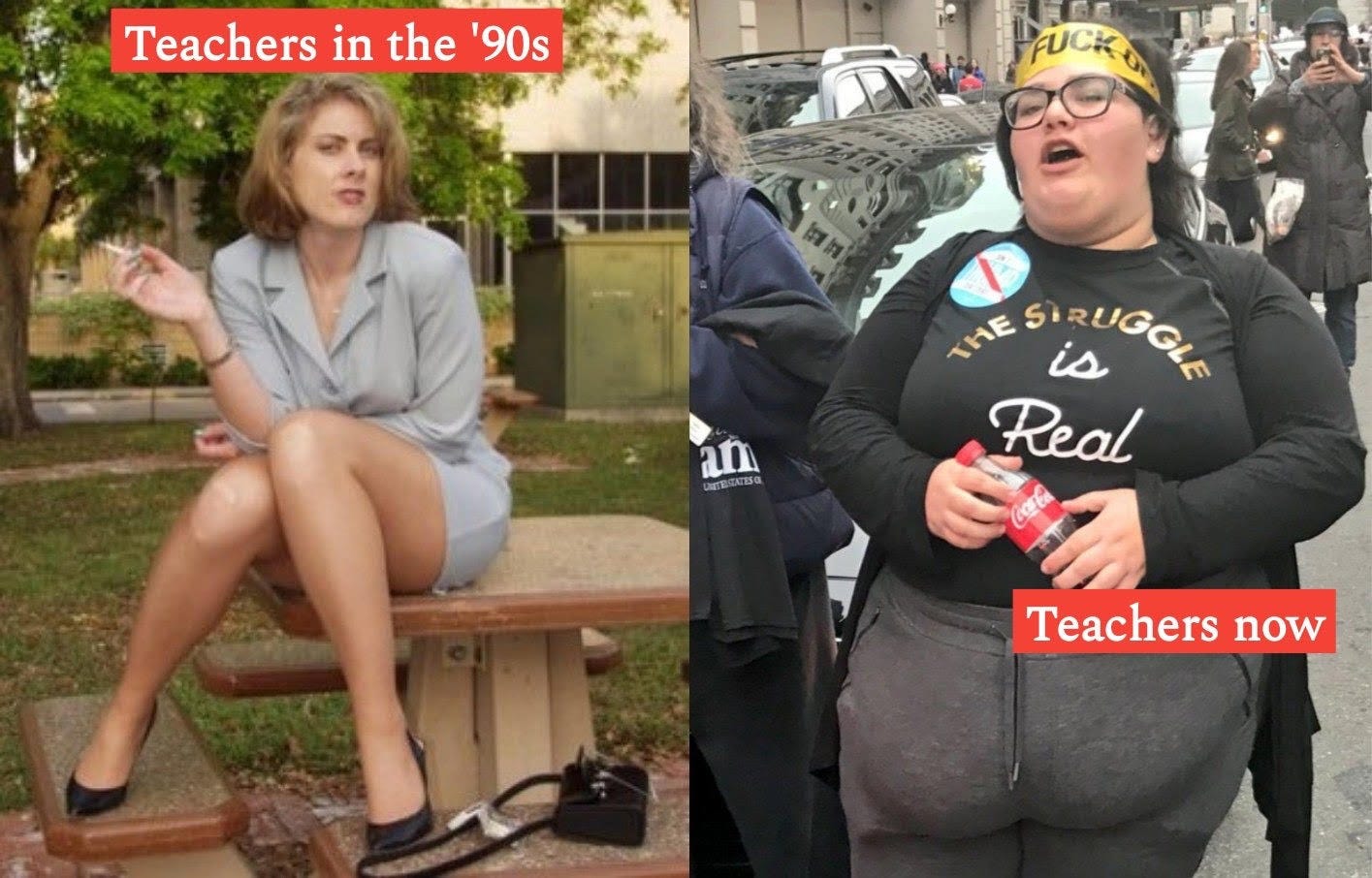
This is what had to happen in order for fat ugly female teachers to be able to stand the existence of boys. If they pathologize us, then they can feel sorry for us, and if they feel sorry for us, then they get to do their favorite thing: have meetings about how sad they are.
Remember when most teachers were pretty, and hardly anybody was autistic?
Hashtag Me Too.
It is a supreme irony that the women who gaslight smart men into thinking they’re autistic are usually also the ones who “hate capitalism.” It seems to me that an essential part of hating capitalism should be the realization that people do not cease to exist when they leave work, and that the sanctum sanctorum of human existence should not be the modern office — the sexless fluorescent environment in which men now need to be indistinguishable from women to be allowed to exist.
Men who wear steel-toed boots and/or nametags at their jobs can be men. Women can meet and fuck them at da proverbial club on the weekends. But the price of wearing a tie to work is castration — and the method of that castration is being gaslighted2 into neurodivergence. This unofficial but still socially binding (because women say so) diagnosis gives every woman in your workplace license to “helpfully” react to everything you say by asking if you need a snack and reminding you to use your inside voice (even though she does not have to stop using her teachermom voice with you).
Though I suppose it was cowardly, I played along with this for years. Though it robbed me of my dignity, “autism” was a convenient excuse that got me out of way worse accusations: better for my emotionless inadvertent infodumping “rudeness” to be officially a disease (and therefore not my fault) than for me to be a SOCIOPATHIC MANSPLAINING BRO WHO IS NEGGING. For a few years there, it was like every man had to be something, and autistic was the only thing I could be and still be “good.”
But I have a family now, and my highest calling in life is no longer to be non-threatening to female co-workers — it’s to be attractive to my wife and strong for my daughter. And if women really cared about other women, they would stop trying to render men useless to our families merely for the sake of their own comfort in the workplace.
Do you remember a show called Secrets of the Zoo? It was on Netflix or something, a half-hour docuseries that gave you a glimpse into the behind-the-scenes goings-on at various zoos. It was interesting sometimes, but there was also a lot of animal euthanasia on it — sometimes for reasons that seemed specious or were not clearly or adequately explained. There’d be a giraffe that seemed fine, and then the next thing you know the zookeepers are giving him a lethal injection and watching him die and crying and hugging about it. And on those episodes, the ones that revolved around euthanizing a big awesome animal, the crying hugging zookeepers were always fat ugly women.
And they were all so sad that the animal “had to” die. They were so sad, in fact, that you’d almost think they were having a competition about who was the most sad. About the fact that the animal “had to” die.
The animal is not big and powerful and beautiful (instead of fat and ugly) anymore. First it was sick. And then it was dead. And then everyone got to cry and hug.
The animal seemed fine to me — but then, I’m extremely rude.
And I don’t follow directions.
And I’m not autistic.
I don’t want to ever put my stuff behind a monthly subscription paywall, but if this essay or other work I’ve created has enriched your life somehow, it would be nice if you gave me like a buck or something: Buy Me a Coffee
My friends at the time. I have no friends now. I stopped having friends shortly after being helpfully informed that I was autistic. I just didn’t feel like it anymore and cut off contact with them, and I haven’t made any new friends since. That was nine years ago.
The psychological sense of the term gaslight, being derived from the title of a play (and later movie), is therefore a proper noun, even though we no longer capitalize it. The past tense should accordingly be gaslighted, rather than gaslit. And no, caring about this does not mean I’m autistic. Caring about grammar is an unremarkable personality quirk, not a symptom of a fucking disease, are you fucking kidding me?! Fuck you. I can’t believe I let you trick me into thinking I had a disease and building my identity around the disease you tricked me into thinking I had for most of my adult life, jesus fucking christ.
At the risk of writing a whole monograph in your comments. I will mention. I grew up in the 80s and was also a weird kid. My parents corrected me when I was rude, but they didn’t understand the depths to which I did not understand other humans. But also, I thought everyone else was weird, not me! So I just went on reading novels (which is actually not a terrible way to learn about humans!) and minding my own business. That plus a few other things, by the time I got to my 30s and learned about “the spectrum” I thought I was obviously on it. It didn’t change anything, I guess, but it was a relief, actually, and a useful way of thinking about myself.
But now I’m looking back and very glad that my weirdness wasn’t medicalized. Like, ok, I needed some explicit instruction in how to interact with people. But also that might have really squished everything that make me special. I am smart and weird; it gives me advantages; I’m creative. The cost is my weakness in navigating complex political groups (like an office culture).
Also you’re definitely onto something with the gender stuff. As a kid, I suspect that being a boy, the other boys (your peers but also the adults) didn’t mind you. But being a girl can be rough when you’re weird. And I also see what you mean about the danger from adult women in your life, both as a child and now.
Good essay!
Pretty much. I don’t disagree with any of this.
You’re simplifying a little—the more neurotypical guys usually don’t like spergs either. But overall, women are usually less fond of them. The more power women have, the bigger a problem autistic traits become, because they don’t like them.
I’ve often thought this, honestly, but good to hear someone else say it so well. Much better put than I could.